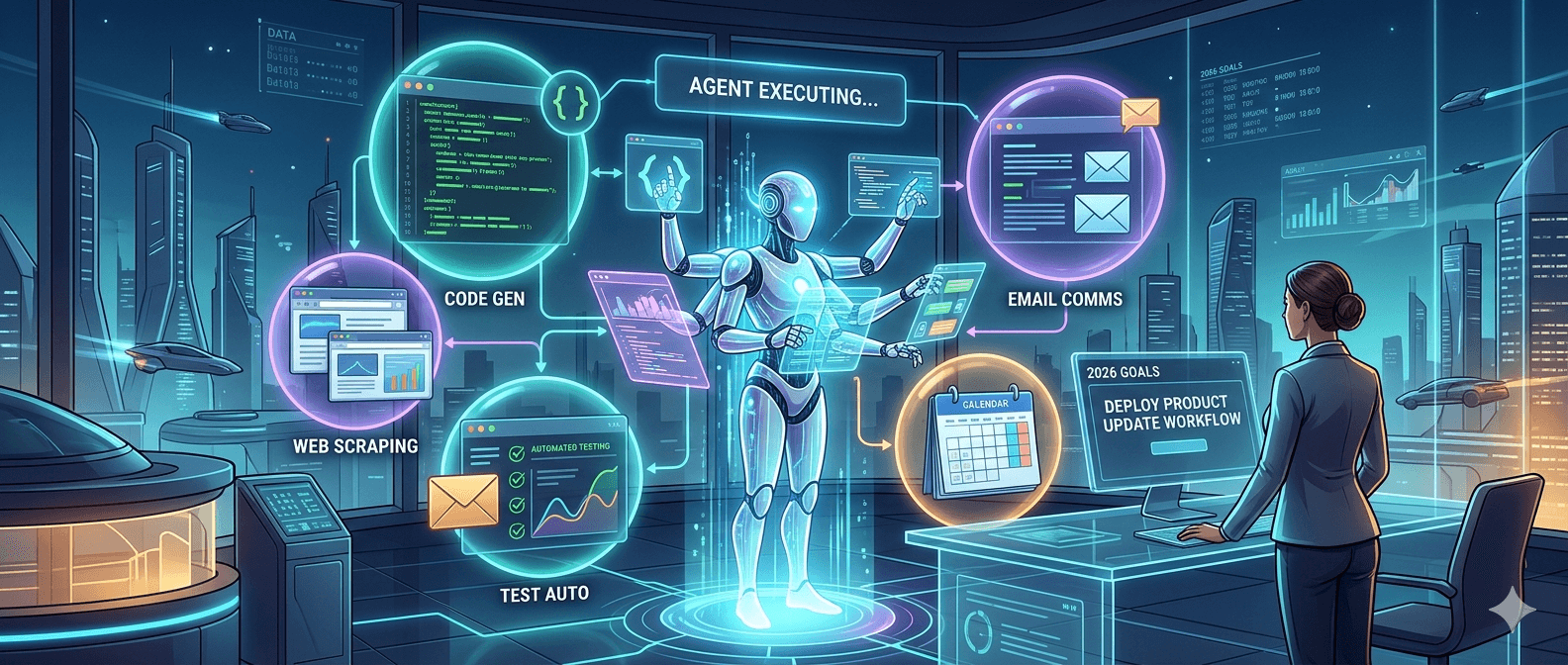
Agentic AI in 2026: The Era of AI That Acts, Not Just Answers
There's a version of AI most people are still thinking about.
You type a question. It gives you an answer. You take the answer and go do something with it.
That version is already outdated.
In 2026, AI doesn't just respond — it acts. It browses the web, writes code, runs tests, sends emails, books meetings, and ships features — all on its own. The shift from AI as a tool to AI as an agent is the most significant change in how software gets built and how businesses operate.
And it's not coming. It's already here.
What "Agentic AI" Actually Means
The term gets thrown around a lot, but the idea is straightforward.
A traditional AI interaction is a single turn: you ask, it answers.
An agentic AI interaction is a loop: you give it a goal, and it figures out the steps, executes them, checks the results, and keeps going until the job is done — or until it hits something it genuinely needs you for.
Think of the difference between asking someone for directions versus handing them your keys.
Agentic AI holds the keys.
Why 2026 Is the Inflection Point
For years, the building blocks existed in isolation. Language models could reason. APIs could execute actions. Browsers, code editors, and databases could be automated.
What changed is the combination.
Modern AI agents can now:
- Plan multi-step tasks without hand-holding
- Use tools — search, code execution, file management — natively
- Recover from errors and adapt mid-task
- Run in parallel, handling multiple workflows simultaneously
The result is a new category of software: systems that don't just assist humans but execute on their behalf.
The Shift Nobody Talks About: From Prompting to Goal-Setting
The most underrated change agentic AI brings is what it does to your role.
Before, working with AI meant crafting the right prompt. The better you were at prompting, the better your output.
Now, the skill that matters is goal clarity.
Can you articulate what success looks like? Can you define the constraints, the edge cases, the acceptable tradeoffs? Can you break a business problem into something an agent can actually execute?
The best people working with AI today are not prompt engineers.
They are systems thinkers who happen to use AI to execute.
What Agentic AI Is Already Replacing
This is the part most people aren't ready for.
Agentic AI is not replacing jobs — not yet, not simply.
But it is replacing tasks, and entire workflows, faster than anyone expected.
Things that used to require a team:
- First-pass research and competitive analysis
- Generating and iterating on functional prototypes
- QA and regression testing
- Customer support triage and routing
- Data pipeline maintenance
Are now being handled, end-to-end, by agents.
This doesn't mean people aren't needed. It means the people who remain are the ones making decisions, not executing them.
The New Infrastructure Layer Nobody Sees
Behind every useful AI agent is a stack of decisions most businesses haven't thought through yet.
- Memory: What does the agent remember between tasks? Across sessions?
- Permissions: What can it access? What should it never touch?
- Oversight: When does it stop and ask a human? What triggers escalation?
- Reliability: What happens when a tool call fails halfway through a workflow?
Getting this wrong is not a minor inconvenience. An agent with too much autonomy and no guardrails is a liability. An agent with too many restrictions is just expensive automation that breaks constantly.
The teams building real value with agentic AI are the ones who've thought carefully about where the human stays in the loop — and where they don't need to be.
Building Products in the Age of Agents
For anyone building digital products in 2026, agentic AI changes the fundamental question.
The old question was:
"What features do we need to build?"
The new question is:
"Which of those features can an agent handle — and how do we design for that?"
Products that get this right are shipping faster, learning faster, and scaling with fewer people. They're embedding agents not as novelty — not as chatbots in a sidebar — but as operational infrastructure.
The distinction matters. A chatbot answers questions. An agent runs your onboarding flow, monitors your analytics, flags anomalies, and suggests what to build next.
At Curaate, this is exactly the direction we're building toward — not adding AI on top of the product creation process, but weaving it into how ideas become working digital products. Faster, smarter, and with far less friction between the idea and the outcome.
The Hidden Risk of Waiting
Here's what doesn't get said enough:
The businesses experimenting with agentic AI right now are not just ahead — they are developing institutional knowledge that compounds.
Every workflow you hand to an agent teaches you something. What needs human judgment. What can be fully automated. Where trust needs to be earned gradually.
That learning doesn't happen by reading about AI.
It happens by doing, failing, adjusting, and doing again.
The teams that start in 2024 will have two years of that institutional knowledge by the time teams that wait until 2026 are just getting started.
If you haven't started yet, the cost of waiting is not just speed — it's everything you're not learning.
What This Means for How You Build
Whether you're a founder, a developer, or a product leader, agentic AI changes your job description in a specific way.
You are no longer just building a product.
You are designing a system where humans and agents collaborate — each doing what they're actually best at.
Humans bring: judgment, creativity, relationship, and accountability.
Agents bring: speed, consistency, memory, and the ability to work while you sleep.
The products that win in this environment are not the ones built entirely by humans, or the ones handed entirely to agents.
They are the ones where the division of responsibility is thoughtfully designed.
Final Thoughts
Agentic AI is not a feature you add. It's a shift in how you think about building.
The question is no longer whether AI can do the task. For most tasks, it can.
The question is: how do you design for a world where it does?
The products being built right now — the ones that will define the next five years — are being built by people who aren't waiting for that question to answer itself.
They're designing for it today.
Are you building a product — or are you building a system that builds the product with you?